Monthly Archives: October 2007

Google & Apple’s iPhone

There is an interesting article over on CNET about Google and Apple outsmarting all of the cell phone companies over the next 5 years. Google is coming out with the “gPhone” (either a phone OS or an actual phone) and Apple has its iPhone. Now, when the iPhone was first coming out Kyle and I talked about how cool it would be to just run Skype on the iPhone over WiFi and just circumvent the cell company. Basically VoIP, but mobile. Super neat!

Well, this now gets more interesting. With Google aimed to bid on the 700MHz spectrum in January, the cell phone landscape could change dramatically. Now we have wide spread WiFi, available at a low cost. You can use your “gPhone” or iPhone to talk to anyone and everyone over this WiFi network. What does this mean? No more traditional cell companies. No more crazy cell phone charges and taxes (granted, there will probably be government WiFi taxes). No more 2 year term agreements that bind you to crappy devices on an even crappier network.

At the end of they day, I think this article has pretty much hit the nail on the head in saying that in the next 5 years, Google and Apple will have snookered the cell business really good. They’ll be the ones left out in the cold.

Apple vs. NBC – iTunes Saga

I’m sure most people are aware of NBC pulling its content from Apple’s iTunes store a few months back. A new article on Apple Insider sheds some more light on NBC’s “position”. Jeff Zucker, Chief Executive of NBC, claims that they wanted to increase download prices for its shows to $2.99 from $1.99. The reason being that they had ONLY earned about $15 million from the service last year. ONLY?!?! ONLY?!?! Jeff, that’s $15 million you wouldn’t have earned on T.V. episodes without iTunes. I’d love to make $15 million without lifting a finger on the back of someone ELSES platform.

You sound like the RIAA claiming that downloadable music is killing the recording industry. Uh, no. Its just killing your profits, so you’re going to take your ball and go home, no matter how much it could affect what you COULD make in the future.

Jeff goes on to claim that Apple made millions by selling its hardware on the back of NBC’s content, money NBC never saw. Uh, yeah, right. Jeff, Apple makes a superior product that people see value in, hence they buy it. Show me some numbers on that claim and I’ll listen. Reading comments such as these only get me more excited that recording artists (and I’m sure we’ll see something similar with film in the future) are taking control of their own content and controlling how its distributed. Tell me Jeff, when NBC can’t make money on commercials anymore, will you take your bat home too and take my DVR away from me?

This Is Why I Love Gmail

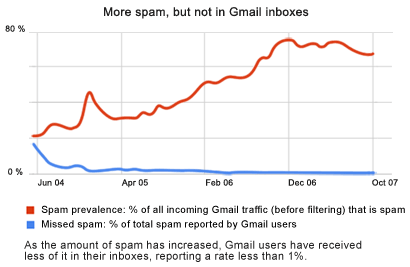
This link via Reddit to a page on Google’s site for GMail shows why I love Gmail so much. More than 70% of mail to hit the GMail system is SPAM. That’s a lot.

GMail Spam Chart

Image Courtesy of Google

What’s amazing is that less than 1% of it gets through to a user’s Inbox. I can definitely see this in what hits my account. Using GMail for all of my emailing needs (I have 10+ accounts set up in GMail), I definitely get my share of SPAM. Especially to a couple of accounts I designate for use when I think I’ll get spammed. What’s great about this is that all of my email gets filtered and flagged by Google so I don’t have to worry about explicit SPAM messages for stuff I don’t care about. The one downside? Well, Google knows a lot about me. But so does the U.S. Government…

Finding New Music

My good buddy Kyle and I are music junkies. Well, Kyle more so than I am. However, we both usually have the same problem. We’re tired of the music we have. Yeah, we can go through our respective music libraries and find SOMETHING to listen to, but its always nice to to have something new. But how do you find it? I usually struggle finding new stuff, but today, I tried something new.

I’m a new fan to a couple of bands The Bees and Maserati. So I thought, heck, I’ll go to the iTunes store (where I got those albums) and see what other people bought who liked those bands. It yielded me three new albums:

Rogue Wave - Asleep At Heaven

Rogue Wave – Asleep At Heaven’s Gate

Rogue Wave is a cool band signed to Jack Johnson’s music label Brushfire Records.


Rogue Wave - Asleep At Heaven's Gate


Caspian - The Four Trees

Caspian – The Four Trees

A similar band to Maserati, Caspian’s music is very instrumental. Besides coming up with cool music, they’re from Masschusetts, where I currently live!


Caspian - The Four Trees


The Thrills - Teenager

The Thrills – Teenager

The Thrills is a cool band, I’d say similar to The Bees in sound that has been around for a while. I think “Teenager” is their third album.


The Thrills - Teenager


All three albums I downloaded are excellent. I’ll definitely be using this technique in the future to find new stuff. I’m not sure why I never thought to do it before. I just wish that my music addiction wasn’t so expensive. At $9.99 a whack, it can get out of hand. How about $5.99 an album Apple???

Is Ecometry Stuck In The Past?

Several months back, Kyle IM’d me a link to the Top 10 Dead (Or Dying) Computer Skills. We both noticed that Ecometry used the first two technologies, Cobol and Non-Relational Databases. Having had our troubles with Ecometry and how backwards it sometimes seemed to how applications are developed today, especially web apps, this gave us a little chuckle.

I recently got a little fired up (here and here) with Ecometry regarding their support billing cycles, so I came back to this article and figured I’d publish it.

There are many reasons companies stay with old technologies. Sometimes it just works, so its hard to justify change. Sometimes the cost outweighs the benefits of developing a new application. But sometimes, just sometimes, to increase market share and keep existing customers, you have to change. I’m not saying companies like Ecometry will ever disappear, I just think that eventually, something better will come along.

What I will say to that effect is that as time goes on, better solutions come out (read web applications) that can do the same things antiquated systems like Ecometry do but better (Ecometry isn’t the most user friendly application in the world). Older companies are either forced to change or die out because people go elsewhere. Think about it, why is Digital Equipment (DEC) gone? Something better came along. Why don’t we use DOS anymore? Something better came along. I think we’ll start to see more and more of this happen with Web 2.0 applications replacing desktop applications (look at some of the Google applications that have come out that are useful, but not yet as powerful as say Microsoft Office) when its possible for them to have the same usefulness and features their desktop ancestors had.

Eventually, as web applications become more and more powerful, legacy applications such as Office and Ecometry will go the way of the Dodo. This isn’t a knock on Ecometry so much as its an observation on my part as the direction of software these days. More and more powerful applications are being developed for the Web as we bandwidth increases and we start to go more mobile.


Usability Testing: The Beginning

We did usability testing for YumDrop way back when we redesigned it the first time. It worked out pretty well. Sales went up. Much success! However, we never did it again. Taboo #1 when it comes to usability testing. I’ve been planning on getting it rolling again lately and finally did with an impromptu session with my brother.

The amazing thing was that I was able to do it OVER THE PHONE! I basically just asked vague questions to see what he thought of different pages on our sites. From the 20 minute session, I was able to get a few good ideas, which is really all you need to start. The only downside of it is I can’t see what he’s clicking on or hovering the mouse over. The important thing I think is that I did it, even if it wasn’t perfect. Something is better than nothing after all.

One thing I was able to get out of Krug’s book was that it doesn’t really matter so much how you do your usability testing (other than a few key approaches), but that you do it and keep doing it. As you continue down the testing road, you’ll continue to improve the stumbling points people have with your web site.

California Wildfires

Unless you’ve been living under a rock lately, you surely know about the California Wildfires that are ravaging San Diego County and other parts of Southern California. Firefighters haven’t been able to get a break lately it seems, but hopefully they will later this week. This touches home particularly for me since my brother now lives in Oceanside, CA which is part of San Diego county.

Image courtesy of CNN.

He was able to call earlier in the week and get an email out saying he was ok (he’d just returned home from his Honeymoon too…welcome back buddy!), but communication is sporadic since authorities want people to limit phone calls to emergencies only (and you can hardly get through anyway). Last I knew, he was 10 minutes from the current evacuation line, but now that Camp Pendleton has been evacuated (his wife works there as a Marine), I’m pretty sure they’ve been told to get out. Hopefully this is all under control soon and my brother as well as everyone else there can return home and get back to their lives.

UPDATE

My brother sent me the following image he took from his car (click for larger version):


The windshield is a little dirty, but you can see how much smoke there is in the air an how the sun is just a faint orange ball. He’s about 10 miles or so from the nearest fires and haven’t had to evacuate, but they’re not out of the woods yet. He said its finally snowing in San Diego (we’re originally all from the Northeast), except there’s no snow. Its snowing ash!

I also found this video that basically shows the same thing. I’m not sure how far my brother is from this guy, but my guess is that they are pretty close.

Book Review: Don’t Make Me Think

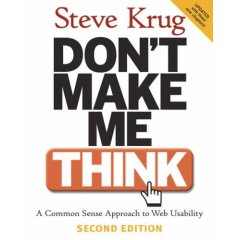
I recently purchased Steve Krug’s book Don’t Make Me Think: A Common Sense Approach to Web Usability for a plane trip to California to my brother’s wedding.


51w8l2zy3wl_aa240_.jpg

Image courtesy of Amazon.com

I was able to read the entire book for the most part in about 2-3 hours (which Steve notes was on purpose). Along the way I kept some notes on a piece of paper as well as some in my head. What I found after finishing was I was starting to look at the web sites I work on (FrightCatalog.com, YumDrop.com, and ImportCostumes.com) in a different way. Steve is very accurate in stating that developer’s look at their web sites very differently than those who will visit them. We think that if we like a design aspect or we find a feature useful, the entire world will. After all, we’re trying to develop for the average user, right? Wrong. There is no average user (and if there was, developers certainly aren’t in that group). We, as developers, aren’t the target audience. The rest of the world is and we need to make sure our sites are as easy to use as possible so people don’t have to (as Steve states time and time again) muddle through.

By the end of the book, Steve delves into Usability Testing, something we’ve only done briefly for YumDrop (and it did work when we did it), but we haven’t continued. We will now. To improve our conversions, we need to get people to look at more product. That means seeing how they use the site and what prevents them from purchasing products. One of the first changes we made was altering the header of the Fright Catalog index page, putting search in the upper left and calling more attention to the button. We found that only 18% of visitors used search, which is abysmal. My guess is they didn’t see it over on the right side of the page where it was before because people scan (they don’t read) web sites left to right (like a newspaper or book). I’ll report later on if that percentage increases.

If you don’t have a copy of it, I highly recommend you buy it. Steve does an excellent job at opening your eyes to a new world of developing web sites and retaining users. I’m really excited to apply more and more of what he talks about in his book to our sites. I’ll also be reading it multiple times, which is easy because the book is short. I’m sure I missed some good tidbits!

Learning From Analytics

We’ve been stuck in a "rut" of sorts for the past few years with FrightCatalog.com redesigning and realigning our site to what we thought would generate more sales.  In the past, this has worked so to speak.  This year, not so much.  Traffic is way up, conversions are flat.  So, we started really digging into the numbers we have collected through Google Analytics.  Based on what we saw and a new way of "thinking", we’re realigned our index page to reflect what we think (based more on numbers now than a gut feeling), will get our customers into sections they really want to see.  If this works, we’ll start to tweak the index page on a more granular level to improve things as well as move these changes into other popular landing pages.

In the end, our SEO is good and our site looks great.  But we have trouble converting our visitors into customers, which is crucial for growth.  Its refreshing to finally be making decisions and changes based on actual numbers instead of a gut feeling.  What we’re really interested at this point is how well we’ll be able to interpret the numbers that are in Google Analytics and see if we can make use of that instead of a paid service such as Omniture.